The tank-type vehicle, considered obsolete by the end of the
20th century, ruled the battlefields of the 21st.
Several factors led to the reappearance of mechanized
warfare. The first was the development of biphase carbide armor (BPC). Stronger
than any steel, it was also so light that even an air-cushion vehicle
could carry several centimeters of protection. The equivalent of a
megaton of TNT was needed to breach even that much BPC armor -- which meant
that, in practice, nothing less than a tactical nuclear device was
likely to be effective.
Infantry, which had for a time eclipsed the tank, declined
in importance. Although an infantryman could carry and direct a
tactical nuclear missile, he had to be extensively (and expensively)
protected to survive the nuclear battlefield. Thus, the "powered
suit" was developed. Four cm of BPC, jet-equipped, it could guard a man for about
a week (in increasing discomfort) from shrapnel, background radiation,
and biochem agents. However, the cost of equipping infantry reduced
their value. They were still more flexible and maneuverable than armor,
and now they were almost as fast -- but they were no longer cheaper.
Long-range nuclear missiles, which had been expected to make
a mockery of "conventional" operations, likewise declined in
value as jamming technology and laser countermeasures improved. Without
satellite guidance, no missile could hit a less-than-city-sized target
at more than 30 km -- and no combatant could keep a spy satellite
operational for over an hour. Missiles big enough to carry jam-proof
guidance systems were sitting ducks for the big laser batteries --
for, although lasers had proved too temperamental and fragile for
battlefield use, they were fine as permanent antiaircraft units.
Thus, the tank-type vehicle -- fast, heavily armed and
armored, able to break through enemy positions and exploit disorganization --
returned to wide use. And once again, planners fretted over priorities.
More guns? More armor? More speed? Increase one, and lose on the
others? Increase all, and build fewer units?
Some interesting compromises appeared. The 21st-century
infantryman, especially with the later "heavy powered suit,"
was a tank in his own right, at least by 20th-century standards. The armed
hovercraft or ground effect vehicle (GEV), equipped with multi-leaf spring
skirts for broken ground, could attain speeds of 120 kph on any decent
terrain, and 150 on desert or water. Conventional tanks were slower but
tougher. All fired tactical nuclear shells.
The ultimate development of the tank-type weapon, though,
was the cybernetic attack vehicle. The original tanks had terrorized unsophisticated infantry. The cybertanks terrorized
EVERYONE, and with good reason. They were bigger (up to 50 meters), faster
(hovercraft models proved too vulnerable, but atomic-powered treads
moved standard units at 45 kph or better) and more heavily armed (some had
firepower equal to an armor COMPANY). And two to three METERS of BPC
armor made them nearly unstoppable. What made the cybertank horrifying,
though, was its literal inhumanity. No crew was carried; each unit was
wholly computer-controlled. Although true mechanical intelligence
had existed as early as 2010, and fully automated factories and military installations were in wide use by the middle of the century,
the cybertanks were the earliest independent mobile units -- the
first true war "robots."
Once the first cybertanks had proved their worth,
development was rapid. The great war machines aroused a terrified sort of
fascination. Human warriors devoutly hoped never to confront them, and
preferred to keep a respectful distance -- like several kilometers -- even from
friendly ones. They were just too BIG.
One fact, more than anything, points up the feeling that
developed toward the cybertank. Unlike other war vehicles, they were
never called "she." Friendly units of the speaker's
acquaintance were "he;" others were "it." And the term "cybertank" was
rarely used. People had another name for the big war machines -- one drawn from the early
Combine units and, before that, from dark myth.
They called them Ogres...
========================================================================
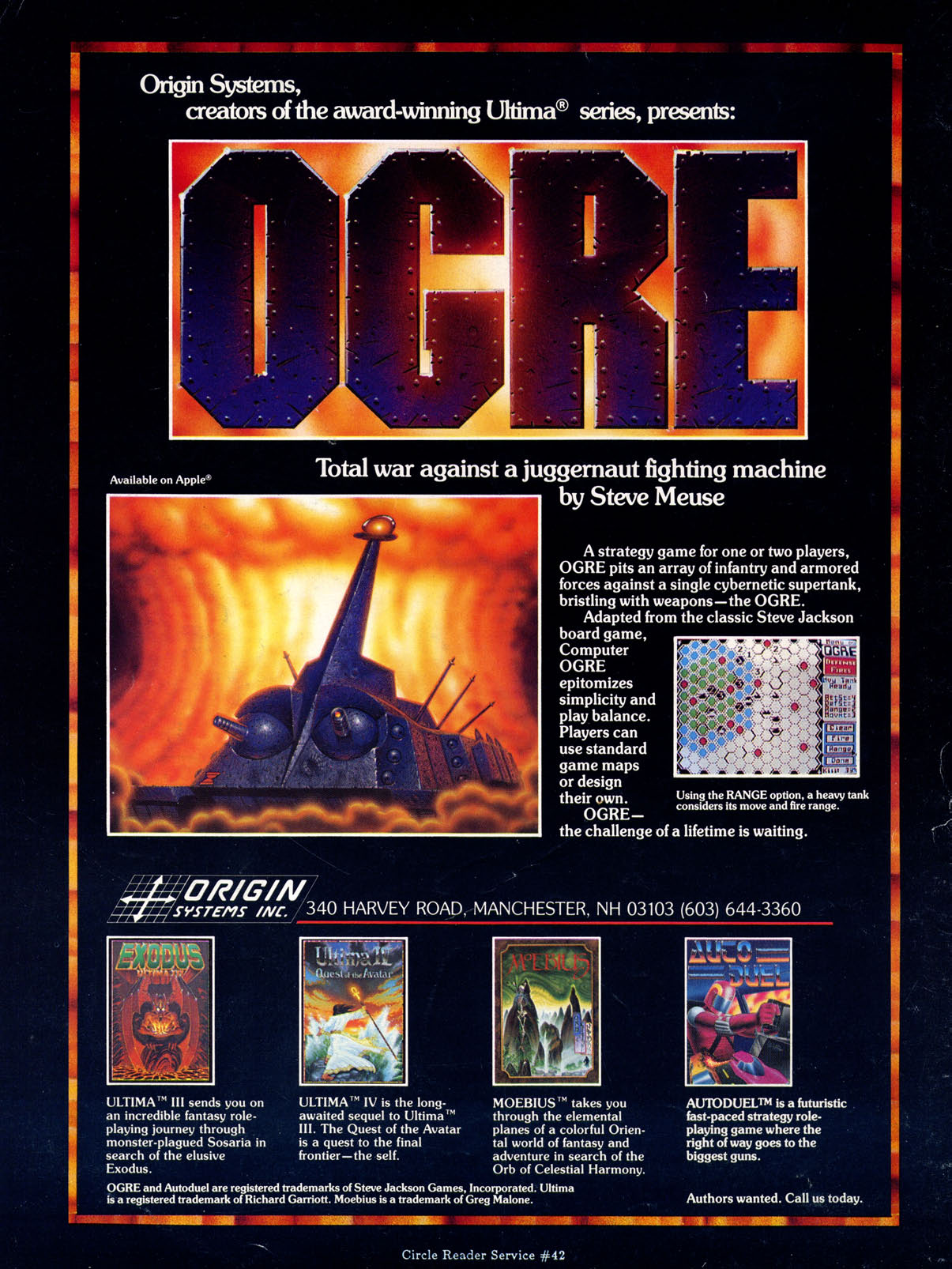
Steve Jackson's pen and paper Ogre brought to virtual life on the Apple II. This game comprises of the Basic and Advanced scenarios for the first edition of Ogre from 1977. Two players may play the game as intended (one player operating the cybertank, the other defending the command post using normal units) or one player may "match wits" against the Apple by having the computer control the Ogre while the player defends his command post.
Badges
OGRE - Apple II Game Play Screenshots
--------------------------------------------------------------------------------------------------------------------------
---------------------------------------------------------------------------------------
p.46
p.110
-------------------------------------------------------------------------------
---------------------------------------------------------------------------------
-----------------------------------------------------------------------------------
----------------------------------------------------------------------------------
--------------------------------------------------------------------------------
-----------------------------------------------------------------------------------
---------------------------------------------------------------------------------
---------------------------------------------------------------------------------
--------------------------------------------------------------------------------------------------------------------------
-------------------------------------------------------------------------------------
--------------------------------------------------------------------------------------------------------------------------
Additional Sources:
Virtual Apple 2 - Play OGRE Online
IGN.com - Ogre Manual (In-Game Manual Version)
Gamesdbase.com - Gameplay video (MSX 2 Version)
Xtcbandonware.com - Download and play DOS version


.jpg)
.jpg)
.JPG)
.jpg)


.jpg)
.jpg)
.jpg)
.jpg)

.jpg)


.jpg)


.jpg)


.jpg)
%2B(614x800).jpg)
%2B(618x800).jpg)


.jpg)